
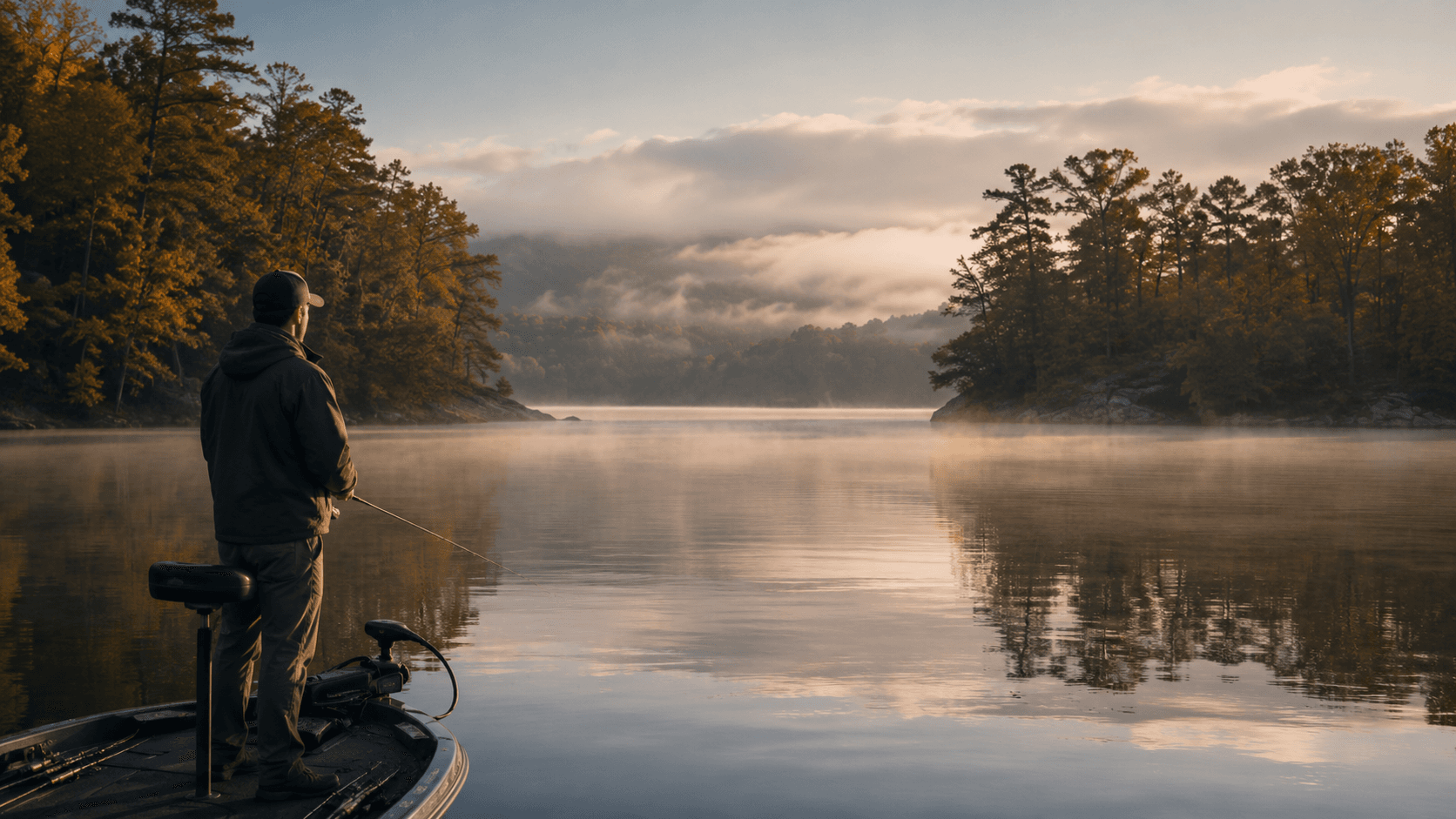
Unfamiliar water is not a problem of luck. It is a problem of elimination. Most of any lake holds no fish at all, and your job in the first hour is to delete the empty parts.
Start with the edges
Fish relate to transitions, not to open water. Every useful spot on a lake is a place where one thing becomes another: weed line to sand, rock to mud, shallow flat to a sharp drop, shade to sunlight. Find the transitions and you have found the fish, or at least the neighborhood.
The first hour
Work the first sharp drop off a flat. Then the outside edge of any vegetation. Then any hard structure that touches deep water, such as a point, a riprap bank, or a bridge piling.
If nothing happens in an hour, the depth is wrong, not the lure. Change depth before you change baits. Most anglers do the opposite, and most anglers spend the day in the wrong three feet of water.
Ask the water, not the internet
Look for bait. Look for birds working. Look for current, even in a lake, because wind pushes plankton, plankton pulls baitfish, and baitfish pull everything else. The windy bank is almost always better than the calm one, which is why almost nobody fishes it.