
You've just landed a fish, and the first glance seems easy. The body looks dark, the fins are partly folded, and the water is reflecting straight into your eyes. Then the fish rolls, slime covers the flank, a hook hides the mouth, and the color you thought would identify it no longer looks dependable.
That's where a fish identification key earns its place. Instead of matching a fish to a photograph based mainly on color, you follow a sequence of observable structural choices. Body shape, mouth position, barbels, fin arrangement, and fin-ray counts give you evidence you can test, even when light, stress, age, or handling changes the fish's appearance.
Table of Contents
- Understanding the Fish Identification Key
- How Dichotomous Keys Work for Anglers
- Key Morphological Categories for Game Fish
- Detailed Entries for Common Lookalike Species
- Navigating Regional Nicknames and Cross-References
- Overcoming Field Identification Pitfalls
- Quick-Reference Guide for On-the-Water ID
- Seasonal and Habitat Clues for Final Verification
Understanding the Fish Identification Key
A fish identification key turns an uncertain visual judgment into a series of smaller decisions. At each point, you compare two contrasting statements, called a couplet, and choose the one that fits the fish in front of you. The next choice removes more possibilities until you reach a family or species match.
That method is a standard taxonomic tool, not a shortcut invented for recreational fishing. Fisheries education materials describe dichotomous choices as the core algorithm for organism identification, and field resources use the same logic to organize fish by visible characters. Texas Parks and Wildlife's dichotomous key illustrates the classroom version, with choices based on features such as body form, barbels, spots, stripes, fin counts, and eye position.
Why color causes trouble
Color is useful as a supporting clue, but it's a weak foundation by itself. Water clarity changes how a fish looks. Low light dulls markings, bright sunlight exaggerates contrast, and a stressed fish may not show the same tones as one resting in clear water. Age, sex, habitat, and preservation can also alter coloration.
Suppose you're comparing two bass that share a greenish body and a dark lateral stripe. A photograph may suggest an answer, but the stripe can be faint, the angle can hide the jaw, and the fish may be wet with reflective slime. A key asks better questions: where does the mouth reach, how is the dorsal fin shaped, and which structural traits remain visible?
Field principle: Treat color as confirmation, not as your first decision.
What the key is really doing
The key narrows the problem from broad to specific. You might begin by deciding whether the fish has barbels, then examine the mouth, fins, body profile, and other diagnostic structures. You won't need every feature at every branch. Well-designed keys can skip species that lack a particular character, reducing unnecessary steps. FAO identification-key guidance describes this structured approach and notes that keys can be arranged by region, order, family, country, or ecosystem.
The method has deep roots in fisheries science. The Texas A&M Gulf States Marine Fisheries identification-key resource connects modern key systems with long-standing morphology work, including the extensive use of fish scales in species identification since the early 1900s. FishBase's identification-key library lists 1,668 keys, including more than 300 for African inland waters, showing how widely the method has been digitized across major fish regions.
How Dichotomous Keys Work for Anglers
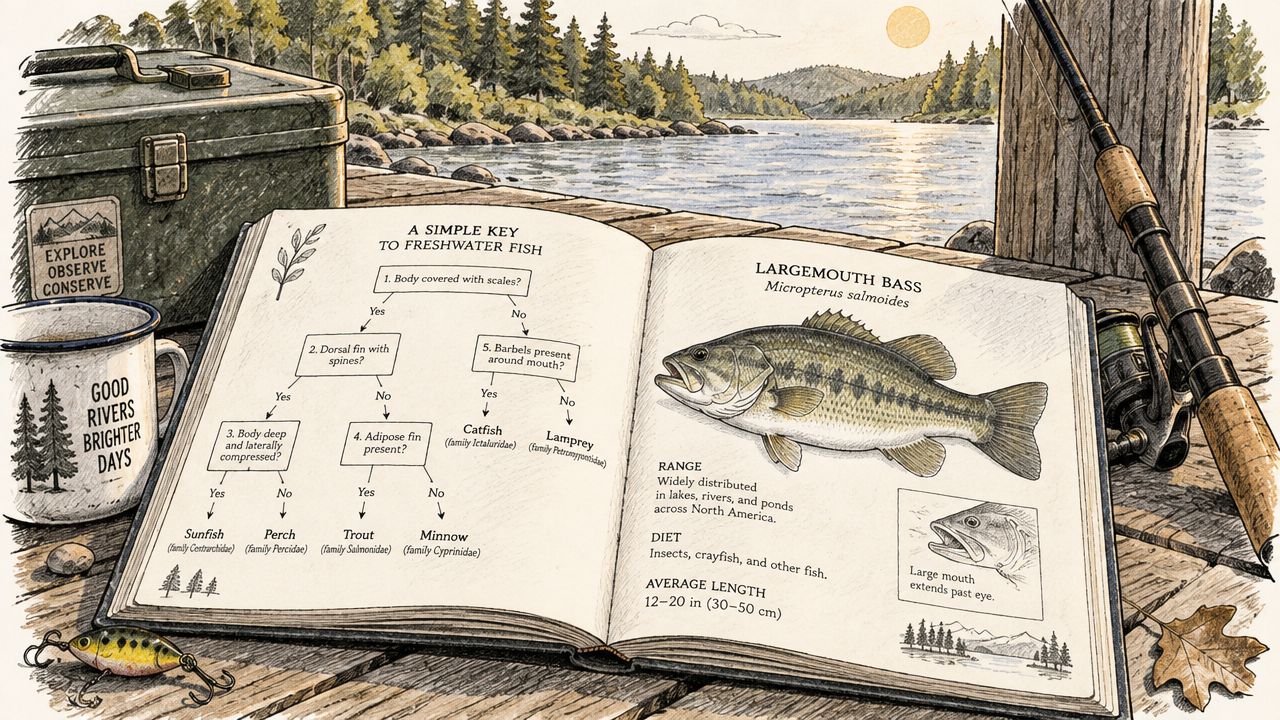
A dichotomous key works like a trail with two marked directions at every junction. You don't choose the fish that “looks closest.” You inspect a character, select the statement that matches, and follow the instruction attached to that choice.
Start with the whole fish, then move toward details. Keep the fish supported and wet if you're releasing it, and use a photograph or written notes for traits you can't inspect safely.
Follow the couplets in order
Use this practical sequence:
- Read both choices completely. A couplet may distinguish “mouth reaches behind the eye” from “mouth does not reach behind the eye.” Read both before deciding.
- Inspect the stated character. Don't substitute a nearby feature. If the key asks about mouth position, look at the mouth in profile rather than judging the head by shape.
- Choose only what you can support. If a fin is damaged or hidden, mark the branch as uncertain instead of forcing an answer.
- Follow the reference number or link. The result may send you to another couplet, a family, or a species profile.
- Check the endpoint. Compare the final description with the entire fish, not just the trait that brought you there.
A simple bass example
Imagine an unknown freshwater bass. The first choice might separate fish with a notched dorsal fin from fish whose dorsal sections are less distinctly separated. If the fin structure points toward a bass group, the next couplet might use mouth position.
Now suppose the key presents two options:
- The upper jaw reaches back to, or beyond, the rear edge of the eye.
- The upper jaw ends before the rear edge of the eye.
You examine the fish from the side and select the matching statement. The key then narrows the possibilities further using body markings, fin structure, or another stable trait. You're not expected to compare every species on the page. Each correct choice removes branches that don't fit.
Avoiding dead ends
The most common mistake is answering from memory before reading the wording. Another is selecting the nearest visual match when neither statement fits exactly. When that happens, back up one step, clean the viewing angle, and inspect the character again.
A key can lead to a family-level result rather than a final species. That's still useful. An angler-focused explanation of key use emphasizes that reaching the family level can be the practical turning point, after which additional details complete the identification.
Key Morphological Categories for Game Fish
Reliable identification starts with structures that remain informative when appearance changes. A fish's color may fade or intensify, but the relationship between its fins, mouth, body, and head usually gives you more consistent evidence.
Body form and profile
Look at the fish from the side before turning it in your hands. Is the body deep and laterally compressed, long and cylindrical, or tapered toward the tail? Does the back rise sharply behind the head, or does the profile stay relatively level?
Body form is most useful when combined with another character. A deep body alone won't identify a species, but it can separate broad groups and guide you to the right branch of a key. The head-to-body transition, caudal peduncle, and overall proportions also help distinguish fish that share similar markings.
Mouth position and feeding structure
The mouth often provides a strong first separation. Check whether it opens at the end of the snout, points upward, or sits beneath the head. Then compare the reach of the upper jaw with the eye. A fish with a terminal mouth and a fish with a strongly inferior mouth may occupy very different branches even if their body colors overlap.
Teeth can help, but don't rely on a quick look when the fish is stressed or hooked. Observe the jaw safely and avoid placing fingers inside an unfamiliar fish's mouth.
Barbels and sensory features
Barbels are whisker-like projections around the mouth. Their presence, number, and placement can move an unknown fish toward a catfish or another group quickly. If you're working with a catfish, the catfish identification guide can serve as a supplementary reference for body shape, fin structure, tail shape, and mouth features.
Check both sides when possible. A barbel may be bent against the head, hidden by slime, or obscured by the angle of a photograph. Don't mistake a strand of vegetation or fishing line for a biological structure.
Fin arrangement and fin rays
Fin placement often outperforms color matching. Note the number and position of dorsal fins, whether the dorsal fin is continuous or divided, and whether the soft and spiny portions form a visible notch. Examine the anal, pelvic, and pectoral fins as well.
Fin-ray counts can be diagnostic, but they demand care. Spread the fin gently, count from the front toward the rear, and distinguish rays from spines when the key requires it. A folded or torn fin can make an exact count impossible, so use the count as one piece of evidence rather than a forced answer.
Lateral line and tail shape
The lateral line is a sensory canal running along the flank. Its position, completeness, and curve can help separate related fish. Tail shape adds another layer: forked, rounded, squared, or notched forms can direct you toward different groups.
Practical rule: Record two independent structural traits before accepting a species match.
Structural traits also suit modern image-based identification. The 2025 Fish-Vista dataset focuses on detecting barbels, adipose fins, pelvic fins, and multiple dorsal fins, all of which are important in traditional keys but can be difficult to see in outdoor photographs. The Fish-Vista research reference should be treated as a direction for computer-vision work, not as a replacement for careful observation in the field.
Detailed Entries for Common Lookalike Species
Lookalikes create trouble because anglers often compare overall color first. A better approach is to identify the family or broad group, then ask which structure separates the two candidates.
The table below is a field comparison framework. It summarizes the type of evidence to inspect, but local regulations and authoritative regional keys should decide the final identification when the fish matters for harvest, records, or compliance.
| Species Pair | Primary Diagnostic Trait | Secondary Confirmation |
|---|---|---|
| Spotted bass and largemouth bass | Compare the upper-jaw reach with the rear edge of the eye | Check body profile, dorsal-fin structure, and the pattern of spots along the side |
| White crappie and black crappie | Compare body form and the arrangement of dark markings | Examine dorsal and anal fin structure, then confirm with a regional reference |
| Channel catfish and flathead catfish | Compare head shape and mouth structure | Inspect tail shape, fin profile, and overall body form |
| Rainbow trout and brown trout | Compare the overall head, body, and fin-marking pattern rather than one color patch | Use spot placement, body profile, and local distribution as supporting evidence |
| Bluegill and green sunfish | Compare mouth size and head profile | Inspect body depth, fin shape, and the edge of the opercular flap |
Spotted bass and largemouth bass
Anglers often start with the dark lateral stripe, but that marking can be faint or visually distorted. Begin with the mouth. Compare the upper jaw with the rear edge of the eye, then use the body profile and dorsal-fin structure as confirmation.
If the fish is angled toward the camera, rotate your view rather than guessing. A side profile gives you a more dependable comparison than a top-down photograph. If the jaw is hidden by a hook, document the fins and body structure first, then confirm the species from a trusted regional source before keeping it.
White crappie and black crappie
These crappie can overlap in color and general shape, especially in stained water. Body depth, the distribution of dark markings, and fin structure deserve more attention than the apparent shade of the flank.
Count only what you can see clearly. If the dorsal fin is folded, take a quick side photograph with the fin extended naturally, provided handling the fish is safe. A regional key may use a combination of fin-ray counts and body markings, so a single blurry trait shouldn't settle the identification.
Catfish and sunfish comparisons
Catfish identification often becomes easier when you focus on the head, mouth, barbels, and tail. Sunfish comparisons depend more on body depth, mouth size, fin arrangement, and the shape of the head. Local names can blur these distinctions, so record the structural observations before searching by nickname.
For any pair, use this decision order:
- Start with a stable structure: Mouth, fin arrangement, barbels, and body form usually provide a stronger opening than color.
- Add a second confirmation: Look for a separate character that supports or challenges the first result.
- Treat uncertainty clearly: If damage or angle hides the decisive feature, keep the identification provisional.
- Check the local profile: Species ranges and legal definitions vary by region, so use the appropriate agency or reference for the water you're fishing.
Navigating Regional Nicknames and Cross-References
A nickname can identify a fish in one waterway and mislead you in another. “Perch,” “rockfish,” and “stripers” may refer to different fish depending on regional usage, local tradition, or the species common in that fishery.
Start by writing down the name exactly as you heard it, then attach three anchors: the water body, the region, and the physical traits you observed. Search the nickname with those anchors, but don't stop at the first image. Compare the result with the fish's mouth, fins, body form, and tail.
Build a name-to-trait map
A useful cross-reference is more than a list of synonyms. It connects a local name to a standardized species profile, then connects that profile to diagnostic structures. For example, if someone calls a fish a “perch,” note whether the fish has a deep compressed body, a particular fin arrangement, or a mouth that points in a specific direction. The traits let you test the name instead of accepting it.
This approach also helps when two anglers use the same nickname differently. Ask, “Which fish do you mean?” Then ask where it was caught and what it looked like. Habitat and region can narrow the possibilities, but morphology should make the final case.
Cross-reference before using habitat advice
Species-specific information about depth, seasonal movement, and lures only helps if the species label is correct. Applying advice for one “rockfish” to another can send you toward the wrong habitat and the wrong tackle. The sunfish species identification guide is an example of a profile-based reference that can help connect common terminology with field traits.
Use this verification sequence when a nickname appears:
- Capture the local term. Write down the exact word, including alternate spelling or plural form.
- Identify the likely standard name. Use a regional guide, wildlife agency profile, or reputable species database.
- Compare structures. Check mouth, fins, body profile, tail, and any other traits named by the key.
- Confirm the location. A species profile should make sense for the water body and region.
- Separate identification from regulation. Even a confident identification doesn't replace checking current size limits, bag limits, closed seasons, and licensing requirements.
A nickname is a search starting point, not taxonomic proof. Keep the physical description with the name so future catches become easier to compare.
Overcoming Field Identification Pitfalls
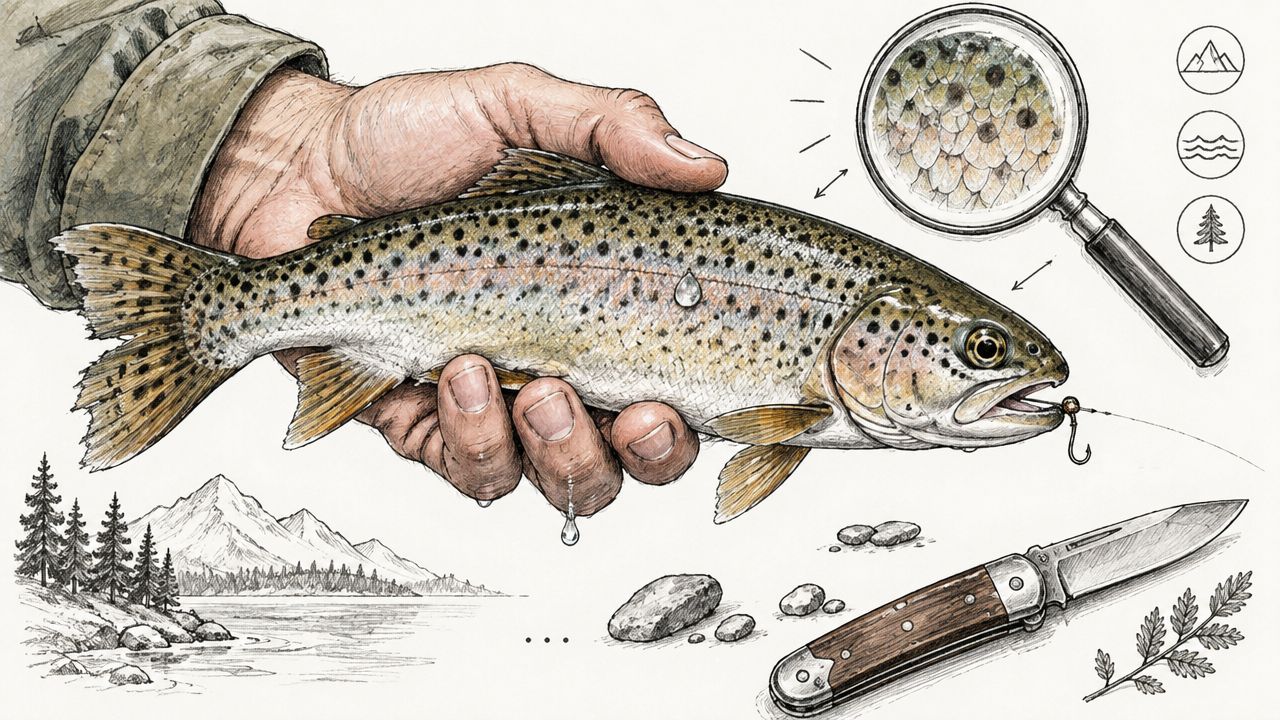
Most keys are easiest to use with a clean, complete specimen on a flat surface. Fishing rarely gives you that specimen. The fish may be twisting in a net, a hook may cover the mouth, slime may obscure the flank, and low light may make a fin edge disappear.
The answer isn't to abandon the key. It's to change the order of operations and recognize which evidence is compromised.
When the fin is damaged
A torn dorsal fin can make a ray count unreliable. Don't keep recounting the same damaged edge and assume a more careful count will solve it. Shift to traits that remain available, such as the number of dorsal fins, the position of the pelvic fins, mouth structure, body profile, and tail shape.
If the key requires a count you can't verify, record that limitation. A provisional family-level identification is more responsible than a precise species label based on a damaged fin.
When the mouth is hidden
Hooks, pliers, and fish grips can block the jaw. Take a photograph from the side after removing the obstruction, if doing so won't prolong handling or harm the fish. Look at the upper-jaw reach relative to the eye, the direction of the mouth opening, and the head profile.
Never force a mouth open just to complete a couplet. If the fish has teeth, spines, or an unfamiliar structure, use a tool and follow safe handling practices. A missing observation is better than an injured fish or an injured angler.
When light and slime distort the view
Rinse your hands and, when practical, gently clear suspended debris with clean water. Avoid rubbing off protective slime. Move the fish into open shade for a photograph, and take more than one angle if the fish is being released quickly.
Use the camera to preserve evidence, not to replace judgment. A side view can show body form and mouth position. A dorsal view can reveal fin arrangement. A close view of the head may show barbels or eye placement. Keep the fish wet and minimize time out of the water.
Corrective habit: If a trait is hidden, change the viewing angle before changing your identification.
Modern image research reflects this field problem. The Fish-Vista dataset information centers on structural traits such as barbels, adipose fins, pelvic fins, and multiple dorsal fins. Those features matter because they're useful taxonomically, yet ordinary outdoor images often show them only partially.
When evidence conflicts, stop at the last confident branch. Note what you saw, photograph the uncertain feature, and verify it later with a regional authority or a specialist reference. A careful uncertain answer protects both the fish and the accuracy of your log.
Quick-Reference Guide for On-the-Water ID
Use this short routine before you decide what you've caught. It's designed for a fast photograph, a tournament check, or a release when you can't work through a full key.
The three-check routine
First, inspect the silhouette. Look at body depth, length, head shape, and tail form. Decide whether the fish is deep-bodied, cylindrical, strongly tapered, or built with a distinctive head.
Second, inspect the front end. Check mouth direction, jaw reach, eye position, teeth, and barbels. If the mouth is covered, change the angle or document the feature for later rather than guessing.
Third, inspect the fins. Note the number of dorsal fins, whether the dorsal sections are connected or separated, the position of the pelvic fins, and the general shape of the anal and tail fins. Count rays only when the fin is spread and undamaged.
A quick evidence note
Record the result in a few words:
- Body: Deep, slender, cylindrical, or compressed.
- Mouth: Terminal, upward-facing, downward-facing, and jaw reach.
- Fins: Dorsal arrangement, tail shape, and any visible fin-ray pattern.
- Location: Water body, depth range, cover, and season.
- Confidence: Certain, likely, or needs confirmation.
A photograph should show the side profile and the head without glare. If regulations apply, don't release or keep the fish based only on a color match. Confirm the species through the relevant local guide or agency resource.
Seasonal and Habitat Clues for Final Verification
Habitat can support an identification, but it shouldn't override a contradictory structural trait. A fish caught in deep, cold offshore structure may fit a different ecological pattern than one found in shallow warm weed beds, yet fish move, water bodies vary, and unusual catches happen.
Use location as a second layer. Ask whether the species you identified commonly uses that depth, cover, current, temperature range, or seasonal position in the water you're fishing. A mismatch doesn't automatically disprove the identification, but it should prompt another look at the mouth, fins, and body profile.
Read the setting without forcing the answer
Seasonal behavior can sharpen a close call. In a river, migratory trout and other fish may occupy different sections as conditions change. In a lake, bass may shift from shallow cover toward deeper structure during warmer periods, while other species may follow forage or current.
The trout species identification guide can help connect trout traits with species-specific reference information, but use habitat as confirmation rather than a substitute for morphology. A trout caught in an unexpected place still deserves a structural check.
Before finalizing your log, combine:
- Physical evidence: The strongest observable couplets from the key.
- Environmental evidence: Water body, depth, cover, current, and season.
- Name evidence: Local nickname mapped to a standardized species profile.
- Regulatory evidence: Current rules from the relevant wildlife agency.
When those layers agree, confidence rises. When they conflict, photograph the fish, release it carefully if appropriate, and verify the identification before reporting a catch or making a harvest decision.
CatchAnything.com provides searchable game fish profiles and decision guides that connect identification traits with habitat, seasons, regional nicknames, and lure categories. Visit CatchAnything.com to compare your field notes with species references and build a more reliable identification routine for your next trip.