
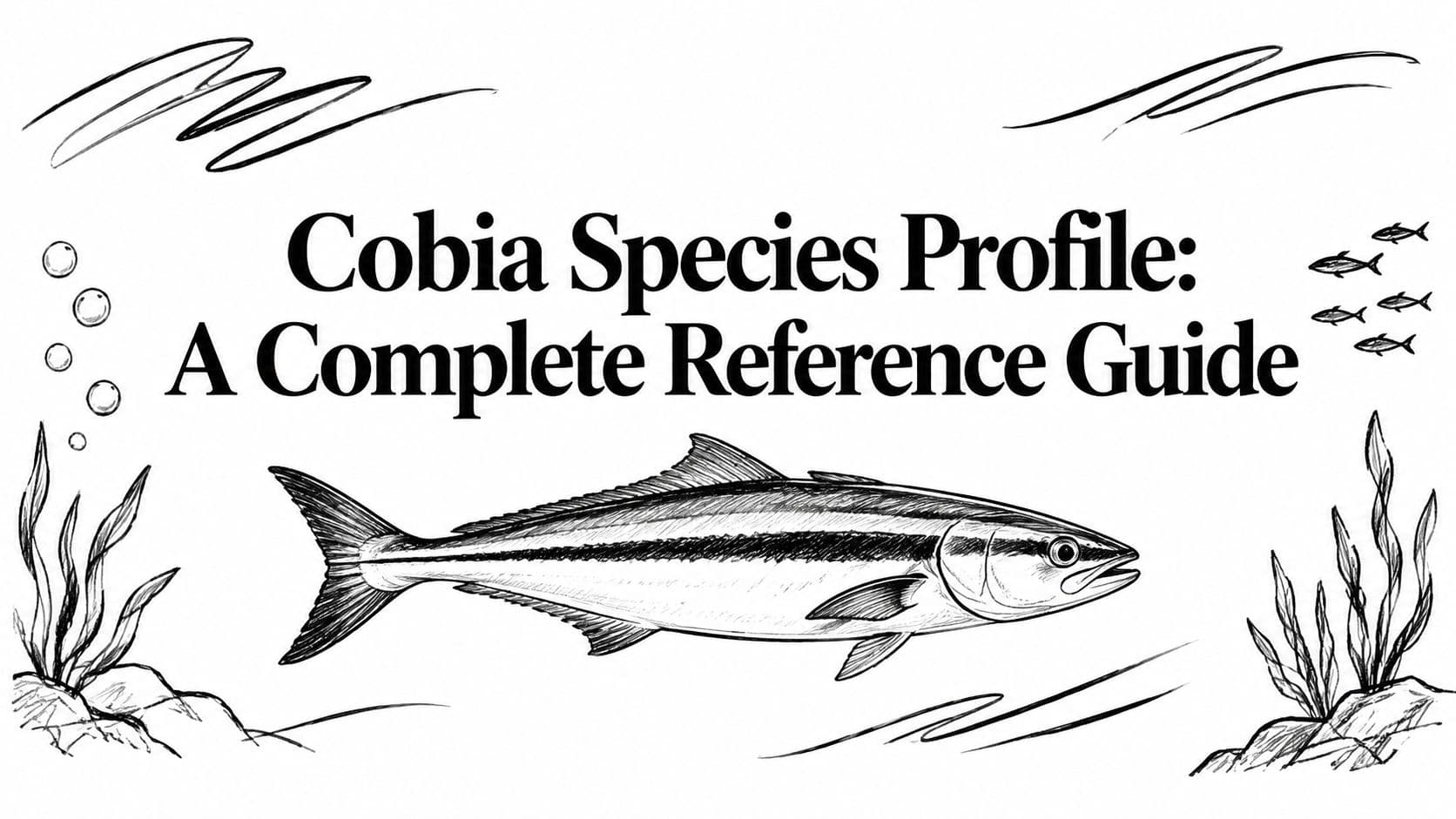
You're easing toward a buoy in calm water when a long, brown shape appears behind a ray. It doesn't behave like a tight school or a nervous baitfish. It glides, turns, and watches the boat. You have a short window to identify it, judge the fish's direction, make a clean presentation, and know whether that fish can legally come home.
That combination makes the cobia such a compelling target. It's a roaming coastal predator with a taste for structure, warm water, and opportunity. The fish may show beside a channel marker, under a shark, over a wreck, or in the wake of a passing ray. The adventure is in the sighting, but the responsibility is in getting the identification, season, location, and regulations right.
Table of Contents
- Meeting the Cobia on the Water
- How to Recognize a Cobia
- Where Cobia Live and Why
- Seasonal Movement and Spawning Cycles
- Behavior, Depth, and Structure
- Baits and Lures That Trigger Strikes
- Typical Sizes and Record-Class Fish
- A Year-Round Cobia Playbook
- Regulations You Need to Confirm
- Cobia vs Similar Species
- Cobia Quick Reference
Meeting the Cobia on the Water
On a calm April morning fifteen miles off Cape Lookout, the wheelhouse gives you a perfect view of the ocean. The surface is nearly flat, the sun is high enough to reveal shadows, and a working cobia ground sits somewhere beneath the boat. You idle toward a channel marker, scan the water, and see a dark shape slide behind a passing ray.
A second fish swings wide. Another cobia circles the buoy, not quite schooling, but clearly using the floating structure as a reference point. The guide cuts the engine, and the whole boat goes quiet. The angler now has to read a living fish in open water, not a mark on a screen.

That moment explains why cobia fishing feels different from dropping bait over a reef. Cobia often announces itself at the surface or just below it. It may follow a ray, inspect a buoy, or appear beside the boat with no warning. The fish is not a deep-water mystery so much as a roaming, structure-loving predator that moves through the upper water column.
The range is broad, from warm Atlantic and Gulf waters to tropical seas worldwide, and the seasonal movement can change the entire character of a trip. Anglers familiar with tarpon behavior and coastal migrations will recognize the same need to read water, current, bait, and structure rather than rely on one fixed location.
Everything that follows comes back to this sighting. Identification matters because a shadow can be a remora, jack, or shark. Range matters because the same fish behaves differently along different coastlines. Regulations matter because a successful cast still ends badly if the season, size limit, or possession rule is wrong.
How to Recognize a Cobia
The first cue is color. An adult cobia usually shows a two-tone brown body, with a darker upper side and a lighter underside. A strong, dark lateral stripe runs from the eye toward the tail, and that stripe often remains visible when glare makes the rest of the fish difficult to read.
Next, look at the silhouette. Cobia have a long, torpedo-like body, a broad and somewhat flattened head, and a lower jaw that projects beneath the upper jaw. The tail is forked, giving the fish a powerful, open-water profile. In the hand, a cobia feels thick and heavy compared with a similarly long jack or remora.
Juveniles can complicate the call. Young fish show distinctive black-and-white horizontal striping along with bronze, orange, and green splotches. Those markings fade as the fish matures, but smaller cobia can still look strongly banded, so don't reject the identification only because the body isn't uniformly brown.

Field cues that settle the question
A row of small dorsal spines sits ahead of the soft dorsal fin. You don't need to count them from a moving boat. Instead, focus on the isolated fin area, broad head, projecting jaw, dark stripe, and heavy body.
Behavior supports the identification, but it shouldn't replace physical cues. Cobia commonly track rays, sharks, and turtles, and they usually move as loose individuals or small, scattered groups rather than a tight school. When one finally eats, the first run feels direct and heavy. The reel loads, the fish accelerates, and its mass becomes obvious before its speed does.
Identification rule: Call the fish from its body and stripe first. Use its association with rays or sharks as confirmation, not as proof.
Where Cobia Live and Why
Cobia are globally distributed in tropical, subtropical, and warm-temperate waters. The western Atlantic range extends from Nova Scotia to Argentina, with strong abundance in warm U.S. waters from Chesapeake Bay through the Gulf of Mexico. They're also reported worldwide except in the central and eastern Pacific, according to the FAO species profile for cobia distribution and habitat.
Their geography makes sense once you consider temperature, prey, and structure together. Cobia are migratory pelagic-benthopelagic fish, meaning they can travel through open water but also spend substantial time close to the bottom or around objects that concentrate food. Continental shelf waters, inlets, reefs, wrecks, jetties, and floating markers provide the edges where a cruising predator can find bait.
Along the Atlantic coast, the Carolinas and Mid-Atlantic become important as warm water moves north. Chesapeake Bay, coastal Virginia, North Carolina, and nearby offshore grounds offer current lines, shoals, markers, and seasonal bait. Florida's east and west coasts remain important at different times because they connect wintering areas with the northward migration.
The Gulf has its own corridors. The Panhandle, Louisiana reefs, Texas jetties, and offshore platforms can all hold cobia when temperature and forage line up. A fish near Panama City in spring is responding to a different local combination of water movement and prey than one encountered off New Jersey in summer.

Cobia don't occupy one reef permanently. They shift along the coast with the water and the food, which is why a reliable local pattern can disappear after a temperature change or bait movement. The best captains track the corridor, not just the coordinates.
Seasonal Movement and Spawning Cycles
Cobia movement follows warming and cooling water, but the calendar differs between the Atlantic and Gulf. In the Gulf, fish occur in the northern Gulf from March to October, while the southern Gulf and south Florida can hold them from November to March. Gulf spawning occurs in coastal waters from April to September, with peak activity in the northern Gulf during May to July, according to the Gulf cobia management document.
Along the southeastern U.S. coast, spawning activity runs from June to mid-August. That broad window matters on the water because fish may gather around inlets, nearshore reefs, current rips, and offshore structure as they move and reproduce. Aggregations can look different from one region to another, so a captain should treat the calendar as a guide rather than a guarantee.
| Region | Months Present | Peak Spawning Window | Typical Movement |
|---|---|---|---|
| Northern Gulf | March to October | May to July | Seasonal movement through coastal and offshore structure |
| Southern Gulf and south Florida | November to March | Spring through summer in Gulf waters | Winter presence followed by northward movement |
| Southeastern Atlantic coast | Spring through late summer | June to mid-August | Northward coastal migration, then southern retreat |
| Mid-Atlantic | Summer | Spawning activity is linked to the broader southeastern window | Fish follow warm water and forage along coastal structure |
Early in a run, sightings around rays, buoys, and markers can dominate the day. Mid-season fish may travel in loose groups through warmer coastal water. Later, heavier cobia can hold around deeper structure as the temperature begins to fall and bait movement changes.
The practical lesson is simple. Don't plan only around a month on the calendar. Check current water conditions, bait presence, and local rules, then expect the fish to relocate when those pieces change.
Behavior, Depth, and Structure
Cobia use the water column as one connected hunting ground. They prefer warm water in the broad range of 68 to 86°F, and they commonly appear from the surface down through nearshore and offshore structure. The most productive sight-fishing encounters often happen where sunlight reaches the water and a floating or fixed object gives the fish a reference point.
That object might be a buoy, wreck, reef, pier, platform, boat, or channel edge. Weedlines and color changes can work for the same reason. They interrupt otherwise featureless water and collect bait, current, or debris. A cobia doesn't need a permanent lair. It needs a useful edge while it cruises.
Rays, sharks, and turtles create moving structure. A large ray disturbs the bottom and unsettles small prey. A shark or turtle can push bait and create a visual target that cobia follow. When the water is clear enough, I scan the back and underside of every large ray rather than assuming it's alone.

Curiosity changes the encounter
Cobia are opportunistic feeders near structure and floating objects. They may inspect a bait, follow a lure, or turn toward the boat instead of fleeing immediately. That curiosity is useful, but it also makes anglers rush the presentation.
A fish that swings toward a jig isn't always committed. A cobia may stare, circle, or follow behind the bait before striking. The captain's job is to keep the boat positioned without crowding the fish, while the angler lets the fish decide whether to eat.
On-water judgment: The fish's curiosity creates the opportunity. Patience keeps that opportunity from becoming a missed cast.
Baits and Lures That Trigger Strikes
Cobia eat a wide range of prey, so rigid bait rules often do more harm than good. The strongest choice is usually the offering that matches what the fish is already following. A live eel, menhaden, blue runner, mullet, pinfish, or croaker presented near a buoy or ray can look natural without requiring much manipulation.
Live bait works especially well when a cobia is visible but undecided. Keep the offering moving naturally, use a circle hook where appropriate, and avoid racing the hookset. Let the fish turn with the bait and build pressure gradually.
Cut bait earns its place when the livewell is short on options. Chunks of ribbonfish or bonito can draw a cobia near structure, particularly when current carries scent past a wreck, platform, or channel edge. The trade-off is mobility. Cut bait can attract a fish, but it won't cover water like a lure or tempt a fish that is actively cruising across the surface.
Artificial lures are valuable when the fish is moving. A 1 to 4 ounce bucktail jig tipped with a soft-plastic eel or paddle tail can be dropped directly into a cobia's path. Vertical jigging over wrecks and towers can reach fish holding below the surface, while skirted trolling lures and large swimming plugs help locate scattered fish.
Practical presentation choices
- Visible follower: Use a live eel or small live bait and let the cobia track it naturally.
- Current over structure: Add a sliding sinker or knocker rig so the bait stays in the strike zone.
- Moving fish: Cast a heavy bucktail ahead of the fish, then let it fall into view.
- No live bait: Use cut bait, a swimming plug, or a jig that can search the structure.
A 5/0 to 9/0 circle hook paired with a 50- to 80-pound leader suits the heavy fish and rough places described in the Spanish mackerel fishing reference. The correct setup still won't save a rushed angler. Wait for the cobia to take the bait, turn, and load the line before applying pressure.
Typical Sizes and Record-Class Fish
A cobia's size changes the whole mood of a day. A school-size fish may appear manageable beside the boat, then turn its broad body and make the angler question every knot. A heavier Mid-Atlantic fish can turn a simple sight cast into a prolonged fight around a buoy, piling, or wreck.
The species can exceed 60 kilograms, and fisheries references document cobia in both commercial and recreational catches, as noted by NOAA's cobia species information. That upper range is why experienced crews treat even a calm-looking fish with respect. Cobia are thick-bodied, powerful, and capable of sudden runs followed by violent movement close to the boat.
A realistic day may involve several smaller fish moving together, one larger solitary fish shadowing a ray, or a single encounter with a mature cobia that dominates the trip. Size varies by region and season, so a captain's expectations should come from local water rather than a universal “average.”
Reading size without a scale
Length gives a useful estimate, but body condition affects weight. A broad fish with a deep shoulder can weigh more than a slender fish of similar length. Rather than promise an exact conversion, use a reference chart as a rough field guide and confirm the weight only with a properly calibrated scale.
| Length (inches) | Estimated Weight (lb) | Size Class |
|---|---|---|
| 36 | Qualitatively light | Nearshore juvenile or small legal fish, where permitted |
| 48 | Qualitatively moderate | Common school or slot-size encounter |
| 60 | Qualitatively heavy | Mature coastal cobia |
| 72 | Qualitatively trophy class | Record-oriented fish |
These size labels are intentionally broad because the available verified information doesn't establish a universal length-to-weight curve. Females can reach substantially larger sizes than males, and fish around nearshore structure in summer may represent a younger class than the heavy adults found on offshore grounds.
A Year-Round Cobia Playbook
Spring is the season of visual opportunity. As warm water moves north, look for cobia near rays, channel markers, buoys, inlet mouths, and nearshore structure. The fish may be traveling rather than holding, so a crew that scans continuously will generally cover more opportunity than one that waits over a single piece of bottom.
Summer brings stronger Atlantic attention from Virginia through the Mid-Atlantic. Fish may spread along current edges, wrecks, reefs, and structure with abundant forage. In the Gulf, spawning activity and coastal movement can keep fish connected to reefs, platforms, and warm-water corridors.
Fall can produce memorable encounters as cobia respond to changing bait and cooling water. Live eels, larger live baits, and bucktail jigs suit fish that are feeding aggressively or holding over wrecks. The fish may move deeper or become less visible, so the day increasingly depends on reading structure rather than relying only on surface sightings.
Winter keeps the southern end of the range relevant. South Florida and nearby warm-water areas can hold cobia while northern waters cool. Deeper structure, current breaks, and bait concentrations become more important than a flat beach sighting.
| Season | Atlantic Region | Gulf Region | Primary Tactic |
|---|---|---|---|
| Spring | Florida through the Carolinas and northward | Coastal Gulf structure | Sight-cast around rays, buoys, and markers |
| Summer | Mid-Atlantic and northern coastal waters | Reefs, platforms, and spawning areas | Work structure with live bait, cut bait, and jigs |
| Fall | Mid-Atlantic and southern migration route | Coastal and offshore structure | Fish live bait and bucktails around wrecks |
| Winter | Southern Florida and nearby warm water | Southern Gulf corridors | Search deeper structure and warm current edges |
The strongest playbook is flexible. Start with the seasonal pattern, then let water temperature, bait, current, and fish behavior decide whether you stay shallow or move to structure.
Regulations You Need to Confirm
Cobia rules are unusually fragmented. A trip that crosses from federal water into a state-managed zone can encounter different size, season, or possession requirements, and those rules can change quickly. The Atlantic States Marine Fisheries Commission cobia page documents recent updates to the Atlantic framework, including a New York emergency rule that raised the recreational minimum size from 37 to 43 inches and changed the vessel possession limit from one to two fish in response to a required harvest reduction.
The management picture also differs by stock. NOAA reports that the Gulf of Mexico cobia stock is not overfished but is subject to overfishing, while the South Atlantic stock is not overfished and not undergoing overfishing. Those assessments help explain why Gulf and Atlantic measures don't always match.
The Atlantic framework has also included a closure of the Atlantic sector to retention for several years under the 2024 measures. Gulf federal waters operate under different rules, while state waters add another layer. Florida, the Carolinas, Virginia, and Louisiana can each set provisions that traveling anglers must verify independently.
What to check before launch
- Federal notices: Review the latest NOAA Fishery Bulletin for the applicable federal zone.
- State rules: Check the fish and wildlife agency for the state where the boat will fish and land.
- Stock area: Confirm whether the trip falls under Atlantic or Gulf management.
- Date and measure: Save the current season, size, and possession language rather than relying on an old screenshot.
- Onboard reference: Use the NOAA Fisheries app or the agency's current digital regulations before leaving the dock.
The same habit applies to any regulated coastal species, including the rules discussed in the red snapper management guide. Never treat a generic cobia profile as a license to retain a fish. Verify the rule for the exact location and date.
Cobia vs Similar Species
A dark shape sliding behind a ray can fool even a seasoned angler when glare, distance, and chop erase the details. On the Atlantic and Gulf coasts, the common mix-ups are juvenile sharks, remoras, and large jacks. Before casting, compare the silhouette, head, markings, fins, and behavior. Misidentification can turn a good sight-fishing opportunity into a released wrong species or a regulatory problem.
A cobia carries a broad, flattened head and a lower jaw that projects beyond the upper jaw. Its dark lateral stripe runs along the body. A shark shows a different head, gill, and fin profile. A remora may look long and dark from above, but the suction disc on top of its head settles the question. Crevalle jacks have a more compressed body, a strongly forked tail, and a yellow-black impression that stands out in clear water.
| Feature | Cobia | Sharks, juvenile | Remora | Crevalle Jack |
|---|---|---|---|---|
| Body | Thick, elongated, torpedo-like | Tapered, often more angular | Slender and elongated | Deep-bodied and laterally compressed |
| Head | Broad and flattened, lower jaw projects | Pointed or wedge-shaped | Flattened with a visible suction disc | Rounded, powerful jack profile |
| Marking | Dark lateral stripe, brown upper body | Gill slits and shark-like fin arrangement | Dark body, disc is the key cue | Yellow and black tones can show |
| Tail | Strongly forked | Shark-shaped caudal fin | Forked but thinner and less powerful-looking | Strongly forked and powerful |
| Behavior | Often solitary or loosely grouped near structure | Cruises independently or with other sharks | Attaches to large animals | More likely to travel in schools |
| Best confirmation | Stripe, head, jaw, body thickness | Snout, gills, dorsal and tail profile | Head disc | Compressed body and jack coloration |
Association alone is poor evidence. Cobia often hold near sharks, rays, turtles, buoys, and other shifting structure, yet a nearby shark does not make every dark fish a cobia. Watch how the fish holds position, then confirm the body thickness, stripe, head, and jaw before committing. The profile settles the identification, especially when seasonal movement puts several species over the same structure.
Cobia Quick Reference
At the dock, keep the mental picture simple. A cobia is a long, thick brown fish with a dark stripe from eye toward tail, a broad flattened head, and a projecting lower jaw. Juveniles may show strong black-and-white banding, while adults usually present a cleaner two-tone body.
The species ranges through warm Atlantic, Gulf, Caribbean, and tropical waters worldwide, excluding the central and eastern Pacific. In North American waters, look for seasonal movement around Chesapeake Bay, the Carolinas, Florida, Gulf reefs, platforms, jetties, wrecks, buoys, rays, sharks, and turtles.
Cobia commonly use the upper water column and structure rather than one permanent reef. Live eels, menhaden, blue runners, mullet, pinfish, croakers, and cut bait cover natural presentations. Bucktail jigs, soft plastics, swimming plugs, and trolling lures cover moving fish. The fish can exceed 60 kilograms, so heavy tackle, careful handling, and a controlled first run matter.
The final item is the one that prevents the worst mistake. Federal Atlantic, Gulf, and state regulations can differ and can change during a season. Confirm the current size, season, possession limit, stock area, and landing rule before every trip.
If you're planning a cobia trip, visit CatchAnything.com to review the species identification cues, seasonal habitat patterns, and lure references before you leave the dock. Use that profile alongside current NOAA and state regulations, then bring the same discipline to the water that you bring to the cast.