
You're halfway through a cast when a heavy fish turns, buries the line in cover, and puts every weak point in your tackle under pressure. The spool may say 20-pound braid, but that label doesn't tell you how much strength remains after the line passes through a knot, gets cinched unevenly, or rubs against a sharp hook eye.
The best knot for braid depends on the connection and the adventure. A Palomar is an excellent terminal knot for a fast bass day, while an FG knot makes more sense when a long leader must pass through the guides during a trophy-fish trip. The right choice gives you a dependable connection without making every lure change or field repair a slow exercise.
Table of Contents
- Why Your Braid Knot Matters More on Big Fish Adventures
- Quick Comparison of the Best Knots for Braid
- How to Tie the Top Braid Knots With Confidence
- Matching the Right Braid Knot to Your Target Fish and Trip
- Why Braid Knots Slip and How to Test Them Before You Cast
- Plan Your Next Trip With Knots You Can Trust
Why Your Braid Knot Matters More on Big Fish Adventures
A largemouth turns into a mat before you can gain control. In that moment, braid's low stretch sends the load straight into the knot, while cover adds abrasion and sudden changes in direction. The knot must suit the fish's first move and the water around it, not just look strong on the package.
Open water creates a different test. A trophy pike may surge beside the boat on a wind-blown flat, and a striped bass can keep taking line after a long cast. A compact terminal knot keeps lure changes quick during a fast bass day. A braid-to-leader connection needs a slim profile and enough consistency to pass through the guides repeatedly, especially on a longer fight.
Printed strength is only the starting point
Independent comparative testing found braid-knot retention ranging from 32.5% to 100.9% of line strength across the knots evaluated (comparative braid knot testing and retention results). That range shows why a high-pound-test braid can still fail at the connection when the knot is poorly suited or badly seated.
The same coverage reported that some braid broke above its labeled rating under controlled conditions. A knot holding only 60% of a 20-pound line leaves about 12 pounds of effective holding power. A knot with higher retention preserves more of the line's available capacity, provided it is tied and cinched correctly.
Practical rule: Choose the knot for the fish, cover, connection, and trip tempo first. Printed pound-test matters after retention and execution.
A trip involving a fish as serious as the one described in this blue marlin fishing guide demands more than a strength ranking. Tie a connection you can inspect quickly, repeat accurately, and trust when the fish makes its hardest move.
Quick Comparison of the Best Knots for Braid
The best knot for braid changes as soon as the connection changes. A terminal knot joins braid directly to a hook, lure, or swivel. A line-to-line knot joins braid to mono or fluorocarbon, where guide passage, leader length, and abrasion become part of the decision.
Best Knots for Braid at a Glance
| Knot | Best Use | Strength Retention | Profile and Tying Notes |
|---|---|---|---|
| Palomar | Braid to hooks, lures, and swivels | Typically 95–100% on braid in a large comparison | Compact, quick, and highly retie-friendly when tied with a fully doubled line |
| FG | Braid to mono or fluorocarbon leader | Reported around 90–100% in braid-to-leader testing, with some comparisons showing lower results depending on setup | Very slim through guides, but demands steady tension and careful seating |
| Berkley Braid Knot | Direct braid-to-terminal tackle | About 124.0% average efficiency in one charted braid test | Strong test performance, though less familiar and not always the fastest choice in wind or low light |
| Uni | Terminal tackle and selected line connections | Usually about 85–90% on braid | Versatile and straightforward, but generally below the Palomar in braid retention |
| Double Uni | Braid to mono or fluorocarbon in the field | Performance varies with line diameter and execution | Reliable emergency join with a manageable learning curve, though bulkier than an FG |
| Albright-style knots | Quick, lighter leader connections | Results vary by line combination and tying quality | Useful when speed matters, but inspect the wraps carefully before fishing |
The Palomar has a long-standing reputation because it combines high retention with a simple sequence. Published testing has placed it at 95–100% of line strength on braid, while the Uni has commonly tested around 85–90% (braid knot strength comparison chart).
The Berkley Braid Knot has also tested strongly in one charted comparison. That doesn't automatically make it the right choice for every trip. If you're changing lures constantly from a moving bass boat, the Palomar's speed can matter more than a small difference in a controlled chart.
For braid-to-leader work, the FG generally earns the advantage because it stays slim and spreads load along a longer contact path. The Double Uni and Albright-style options remain useful when you're retieing beside the boat, on a bank, or in fading light.
How to Tie the Top Braid Knots With Confidence
A knot only performs well when it's seated cleanly. Braid is smooth, and it won't bite into itself or compress exactly like nylon monofilament. Moisten the knot before the final pull, keep tension even, and inspect the finished wraps instead of trusting appearance alone.
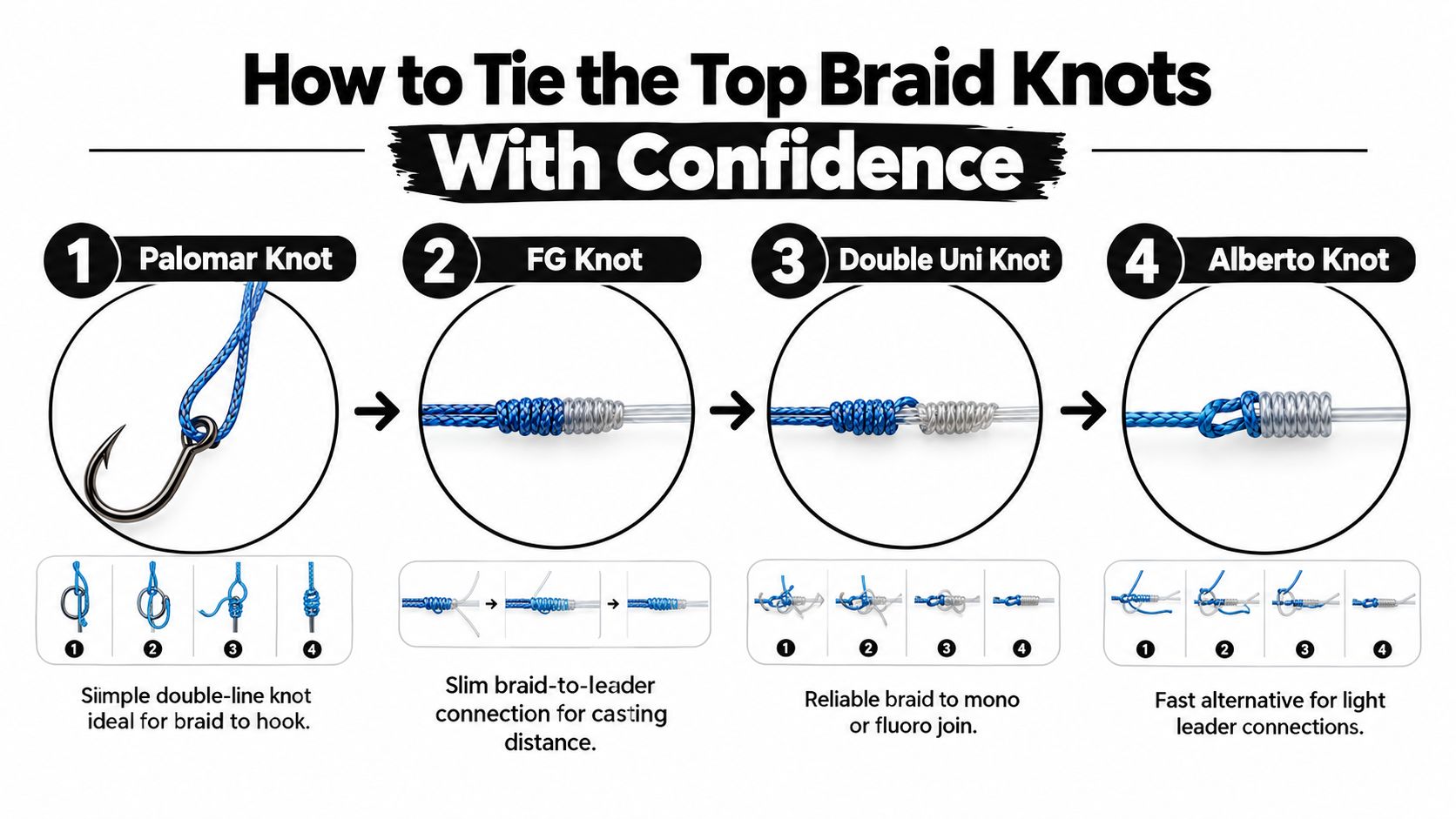
Palomar for terminal tackle
Use the Palomar when braid runs directly to a jig, crankbait, hook, or swivel. Double the line before it enters the eye, then pass the entire loop through. Tie a loose overhand knot with the doubled line, pass the lure through the loop, and pull the standing line and tag end together until the knot settles against the eye.
The finished knot should sit neatly with no crossed strands trapped under the wraps. Leave the loop free around the lure or hook connection, and trim the tag end only after the knot has fully tightened.
Critical detail: If you don't double the line fully through the eye, you've changed the knot and removed much of the reason to use a Palomar on braid.
This is the connection I'd choose for a fast largemouth day, especially when the fish are active and every stop may call for a different jig or crankbait. It's quick enough to retie without turning a productive stretch into a knot-tying session.
FG for braid-to-leader connections
The FG begins with tension. Hold the braid tight against the leader, then alternate wraps so the braid weaves over and under the leader instead of forming a loose coil. Keep the wraps close together and even, then secure the braid with finishing half hitches before trimming.
A properly seated FG looks slender, with the braid gripping the leader along a long, tidy section. Pull both lines steadily before trimming. If the wraps spread, bunch up, or slide instead of locking, cut it off and start again.
The FG's woven, low-profile structure is why it performs well for long leaders that must travel through rod guides. Testing coverage reported that many braid-to-leader knots lose 30–50% or more of braid breaking strength, while top performers such as the FG and GT retained about 90–100% under laboratory tension testing (braid-to-leader knot testing).
Double Uni for field repairs
Overlap the braid and leader so the tag ends point in opposite directions. Form a loop with the braid, wrap it around both lines, and pass the tag end through that loop several times. Repeat the process with the leader, then pull the two knots together until they seat against one another.
The Double Uni is bulkier than an FG, but it's practical when a fish, snag, or abrasion forces a quick leader change away from a tying bench. Use it when you need a dependable field join and can accept a larger connection passing through the guides.
Albright-style connections
An Albright-style knot gives you another fast option for joining braid to a lighter leader. Form a loop in the leader, pass the braid through it, and make orderly wraps down and back along the doubled leader before returning the braid through the loop in the correct direction.
The wraps must lie beside one another rather than crossing. Pull slowly, moisten before the final cinch, and test the connection with steady pressure. This knot can be handy for lighter leader work, but it shouldn't replace the FG when a long, slim connection is central to the trip.
The accompanying video can help you compare the hand movements and final shapes before practicing with your own line.
Matching the Right Braid Knot to Your Target Fish and Trip
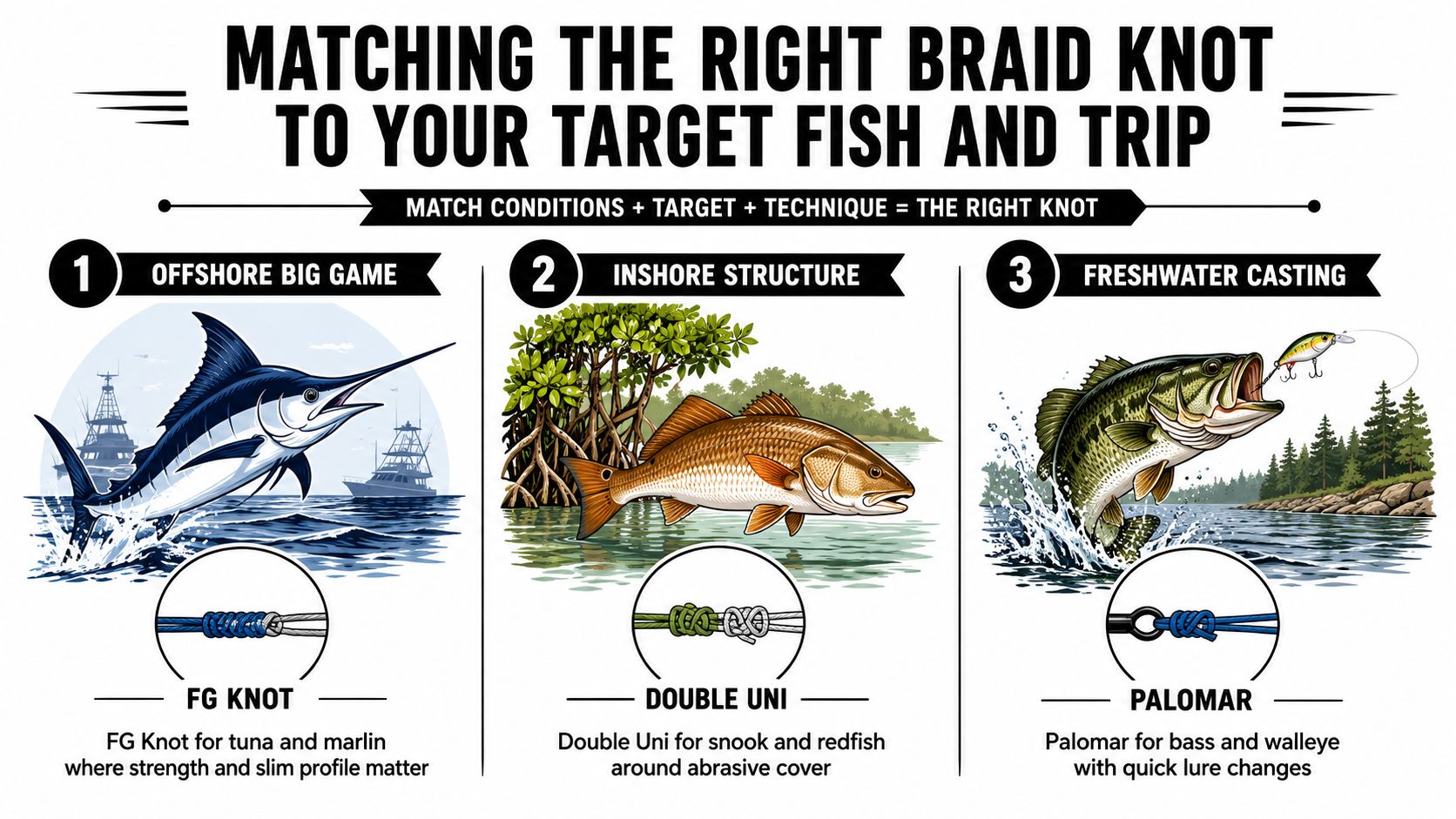
Knot choice makes more sense when you plan backward from the fish. Start with the target, then consider where it will fight, how often you'll change lures, and whether the connection must pass through the guides.
A trophy musky or striped bass setup may use a long leader, particularly when the lure must be cast repeatedly and the connection travels through the rod guides. The FG's slim profile suits that situation. A short, aggressive largemouth trip rewards a Palomar because you can make clean terminal changes quickly.
For inshore snook and redfish around structure, a Double Uni or Albright-style knot can be useful when the day includes frequent leader damage and no comfortable place to tie an FG. The choice isn't about accepting failure. It's about selecting a knot you can tie correctly under the conditions you'll face.
A decision matrix for the day
| Trip situation | Main concern | Sensible starting choice |
|---|---|---|
| Heavy-cover largemouth | Fast, secure lure changes | Palomar |
| Clear-water smallmouth with a long leader | Guide passage and a discreet connection | FG |
| Trophy musky or striped bass with repeated casting | Slim profile under sustained use | FG |
| Inshore structure with likely reties | Field speed and dependable joining | Double Uni or Albright-style |
| Offshore fish where the connection sees sustained pressure | Strength retention and guide clearance | FG |
The Palomar is still a strong choice for terminal braid. Testing has identified it as the strongest mainstream option in one comparison of 30 braid terminal knots, although some tests placed practical failure closer to 63–67% of line strength even for strong knots (terminal braid knot testing). That disagreement is useful. It shows why a knot name can't replace proper tying and testing.
For a trip aimed at a fish with changing seasonal movements, habitat, and lure preferences, the target profile should guide the whole setup. The same planning logic applies whether you're preparing for a river smallmouth run or studying tarpon habitat and seasonal behavior. Your knot should match the moments when the fish is most likely to create trouble.
Why Braid Knots Slip and How to Test Them Before You Cast
Braid slips because its smooth surface gives poorly seated wraps less opportunity to grip. A knot that looks acceptable at the ramp can move under a hard surge if the wraps are crossed, the line wasn't doubled correctly, or the final pull was uneven.
The Improved Clinch can underperform on braid because its compact wraps don't always hold the slick fibers securely. Hook-eye shape and line diameter also matter. A small, sharp-edged eye can damage or pinch fibers, while a mismatch between braid and leader diameter can make a line-to-line knot seat unevenly.
Inspect the connection before trusting it
Look for consistent wraps, a fully seated body, and a tag end that hasn't pulled back into the knot. Then pull steadily against the connection. Don't jerk it with a sudden snap, because a smooth load gives you a better indication of whether the knot is slipping.
Wet cinching helps reduce friction and heat during tightening. If the knot bunches, twists, or shifts under the pull, cut it off and retie rather than hoping the first cast will reveal the problem.
A knot that passes a calm pull test still needs inspection after a snag, heavy fish, or contact with abrasive cover.
Check the first few feet of braid after fishing cover. If the fibers are fuzzy, flattened, or visibly damaged, retie above the worn section. The knot may be sound while the nearby line has become the weak point.
Plan Your Next Trip With Knots You Can Trust
Carry two dependable connections and make them automatic. Use the Palomar for braid tied directly to terminal tackle, and use the FG when braid joins a leader that must pass cleanly through the guides. Keep the Double Uni or an Albright-style knot available for field reties when speed and location make a longer tie impractical.
Practice at home, then pull-test every knot before the first cast. Match the connection to the target fish, the cover, the leader length, and the tempo of the trip. A fast Palomar is often the smart choice for active bass fishing, while the FG earns its place on a long-leader pursuit of a powerful fish, including the preparation described in this swordfish fishing guide.
Before leaving, use species information to check identification, habitat, seasonal patterns, and lure options. Verify current size, bag, and other local regulations with the appropriate state or provincial agency.
Visit CatchAnything.com to match your target fish with practical information on habitat, seasonal patterns, identification, and proven lures before you choose your braid setup. Use those species profiles to plan the adventure, then arrive with the knot that fits the fish and the water.